Chapter 4 — Resource Allocation in Different Economic Systems
Cambridge International AS & A Level Economics (9708) · Unit 1.4 · 4th edition coursebook
Learning objectives
- Explain decision-making in market, planned and mixed economic systems.
- Analyse the advantages and disadvantages of resource allocation in market, planned and mixed economic systems.
Key terms
- middle-income economies
- Economies where income per head was between $1026 and $3995 (lower middle-income economies) and $3996 and $12 375 (upper middle-income economies) in 2018 (World Bank).
- economic system
- The way in which production is organised and choices are made in an economy.
- market economy
- An economic system where most decisions are taken through the market mechanism.
- planned economy
- An economic system where resources are state owned and allocated by a central body.
- mixed economy
- An economic system where both market forces and government are involved in resource allocation decisions.
- market mechanism
- Resource allocation decisions are taken by individual producers and consumers with no government intervention; also known as price mechanism.
- productive resources
- Resources that are available to be used.
- private sector
- That part of an economy under private ownership.
- public sector
- That part of an economy under government ownership.
- privatisation
- Where there is a change in ownership from the public to the private sector.
- emerging economy
- One that is making quick progress towards becoming a high-income economy.
- Asian Tiger economy
- Export-led, high growth economies in Asia.
4.1What are economic systems?
Scarcity forces choice, and choice has to be organised. A country's economic system is the means by which households, firms and the government make decisions about the three resource-allocation questions introduced in Chapter 1:
- What goods and services should be produced?
- How should they be produced?
- Who should receive what is produced?
The fundamental problem of scarcity is common to all economies regardless of income level; what differs is how each economy answers these three questions.
Economists traditionally identify three main kinds of economic system: the market economy, the planned economy, and the mixed economy. In a market economy, resource-allocation decisions are made by individuals and firms acting through the market mechanism, with little or no government involvement. In a planned economy, resources are state-owned and allocated centrally. In a mixed economy, both the market and the state share the allocation task.
Over the past 30 years or so, many planned economies — in Central and Eastern Europe, the former Soviet Union, and parts of southern Asia — have transitioned into mixed economies. The market plays an increasing role in these economies even where the state retains substantial influence.
Key concept link — scarcity and choice
Scarcity and choice apply in all economic systems. How choices are made in an economic system depends on the relative importance of government and the market mechanism.

In a market economy, prices act as signals and incentives — high prices signal scarcity and reward suppliers, low prices the opposite. Option C – prices are used to signal the value of individual resources – states this correctly. A and B misdescribe command economies (which lack profit-driven competition and private ownership), while D wrongly assigns central planning to a market economy.
4.2The market economy
In the market economy, resources are allocated by the forces of demand and supply working through the price mechanism. Decisions about what is produced, how it is produced, and for whom are taken — over and over, in millions of individual transactions — by households and firms as buyers and sellers. The government does not direct allocation; the price signal does.
Figure 4.2 illustrates how this works in the case of an initial surplus. If too much of a good is being produced relative to demand, excess supply piles up in shops and warehouses. To shift the stock, firms cut prices. The lower price clears the surplus, but it also means some producers — those whose costs are too high to make money at the new price — leave the market. With supply now reduced, the price rises again. Higher prices may then attract new entrants, restoring supply. The cycle continues. In a market economy, prices and the self-interest of individuals and businesses act as the guide to every production decision.
The role of government in a market economy
In principle the government does not interfere with the price mechanism. Its role is limited to watching how markets work and stepping in only when the market fails to produce the best outcome. Where markets do fail — for example, goods like healthcare that would be underprovided, or fire services that would not be supplied at all, or industries where producers gain excessive market power — the government intervenes to correct the failure or to regulate. Figure 4.3 summarises the relationship between government, firms, and households mediated by the price mechanism.
No real-world economy is a pure market economy. Even economies usually held up as market exemplars have governments that supply some public services and regulate certain activities. The pure market economy is a theoretical benchmark rather than a real-world arrangement.

In a free market the interaction of buyers' demand and sellers' supply determines the equilibrium price; both sides are essential to price formation. Option C – they are both significant in setting the market price – captures this. Markets allocate by willingness and ability to pay, not equal distribution or universal access (B, D), and they respond to effective demand rather than 'greatest need' (A).
4.3The planned economy
The planned economy — sometimes called the command economy or the centrally planned economy — is the mirror image of the market economy. As with the market economy, the pure planned economy exists more clearly in theory than in practice.
In a planned system, the government takes a central role in every allocation decision. What is produced, how it is produced, and who receives it are all chosen centrally, by planning boards and state agencies. Consumer preferences and firm-level decisions are subordinated to central plans. The state owns most of the productive resources; private ownership is typically confined to small enterprises such as shops, restaurants and personal services.
Key features include: central organisations responsible for resource allocation; production targets set for major sectors such as agriculture and manufacturing, usually linked to long-term growth in productive capacity; controls on the prices of essential goods; and centrally set wages. Because prices do not adjust to clear markets, queues and shortages are common — typically the result of artificially low prices set for political as well as economic reasons.
Governments of planned economies tend to set different goals from those of market economies: catching up rapidly with the productive capacity of more advanced economies. Today very few economies remain fully planned. Where they exist, they pursue centralised production targets in pursuit of state-defined growth objectives.

In a planned (command) economy the central government, not the price mechanism, decides what, how and for whom to produce. Option B – the decisions of central government – captures this allocation mechanism. Demand and supply (C) describe a market economy, a mixture of private and central decisions (A) describes a mixed economy, and tax revenue (D) is a financing matter, not the allocation mechanism.
4.4The mixed economy
The mixed economy is the typical real-world economic system. In a mixed economy, both the private sector and the public sector share the work of allocating resources. Decisions involve interactions between firms, workers and government, mainly mediated by the market mechanism. Most productive resources are privately owned, but the state also holds some.
The dominant trend over the past three decades has been privatisation — the transfer of resources from public to private ownership. This has happened across many emerging economies in Europe and Asia, as well as in formerly planned economies that have moved towards mixed systems. In some cases, opening up these economies has attracted large inward flows of foreign investment, especially in manufacturing and retail; in others, former state-owned firms have been sold to private owners who profited substantially by adapting to market conditions.
The increased emphasis on market forces has costs as well as benefits. In some high-income economies, manufacturing jobs have been lost as production has moved to lower-cost locations. Restructuring the economy from a planned to a more market-led system is therefore a process of both gains (efficiency, choice, investment) and losses (unemployment in declining sectors).
Different mixed economies occupy different positions on the spectrum between pure market and pure planning. Some — historically the Asian Tiger economies — sit close to the market end, with governments creating conditions for free enterprise. Others place more emphasis on central planning, with the state directing investment and protecting strategic industries. Figure 4.5 provides a broad illustration of where selected economies sit on this spectrum. To varying degrees, all real economies fit within the definition of a mixed economy.
Key concept link — scarcity and choice
The fundamental economic problem exists in all three types of economy.

A mixed economy is defined by the coexistence of market forces and government intervention; the state taxes, regulates and provides goods the private sector under-supplies. Option A – the government has no role in setting prices – is therefore not characteristic; through indirect taxes, subsidies, minimum wages and price controls, mixed-economy governments do influence prices. B, C and D each describe routine state activities in a mixed system.
End-of-chapter practice
Past-paper questions from CIE 9708. Pick A, B, C or D. Answers are saved on this device — press Download report (PDF) at the top to save them.
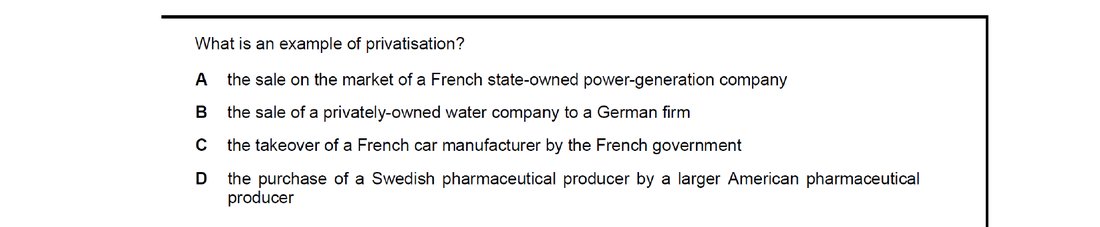
Privatisation is the transfer of assets from the public sector to private ownership. Option A – the sale on the market of a French state-owned power-generation company – is exactly such a transfer. B and D are private-to-private sales (no change in public/private status), while C describes nationalisation, the reverse of privatisation.
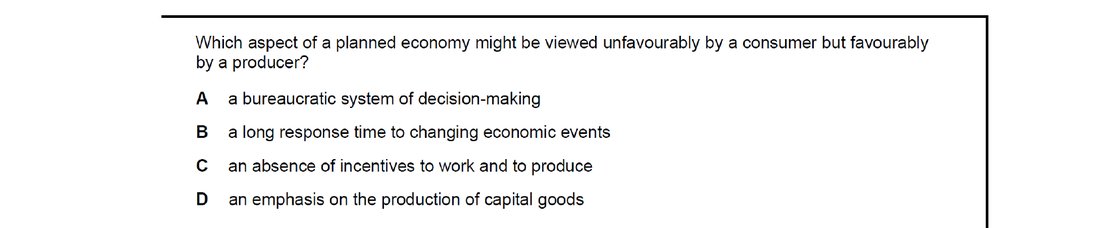
Planned economies historically prioritised heavy industry and capital goods to drive long-term growth, which suppressed current consumer-goods supply. Producers (the state) saw this as a strategic strength, but consumers experienced shortages of consumer goods and limited choice. Option D – an emphasis on the production of capital goods – is the feature with that asymmetric appeal. A, B and C are negatives for both sides.
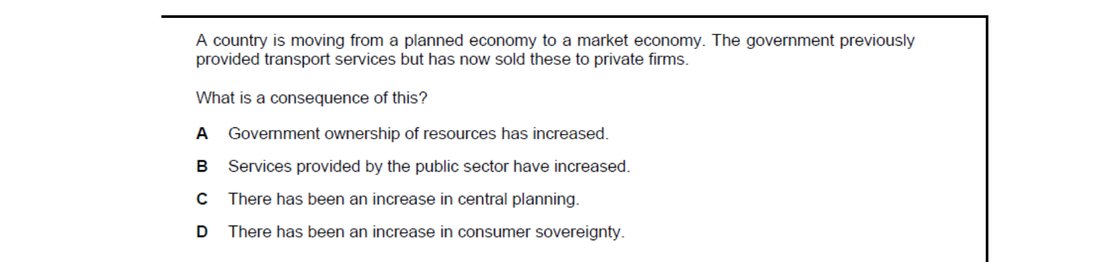
When transport services move from state to private provision, allocation shifts towards the price mechanism and consumer choice drives what is supplied. Option D – an increase in consumer sovereignty – captures this. Government ownership falls (not rises, ruling out A), public-sector provision shrinks (ruling out B), and central planning is reduced rather than increased (ruling out C).
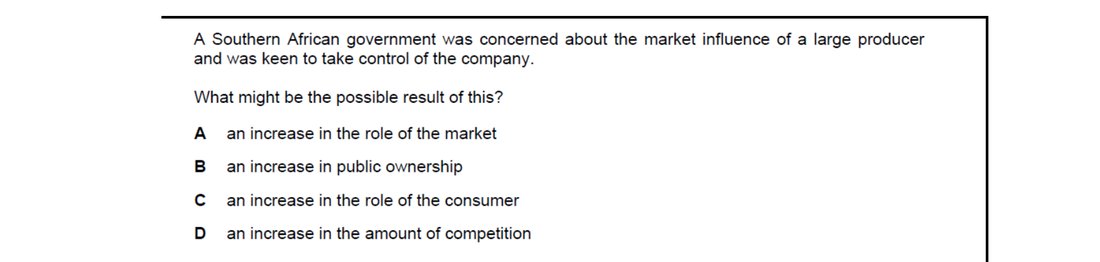
When a government takes control of a private producer, ownership shifts from the private to the public sector — the classic definition of nationalisation. Option B – an increase in public ownership – is the direct consequence. The market role, consumer power and competition (A, C, D) tend to fall, not rise, when a large producer is brought under state control.
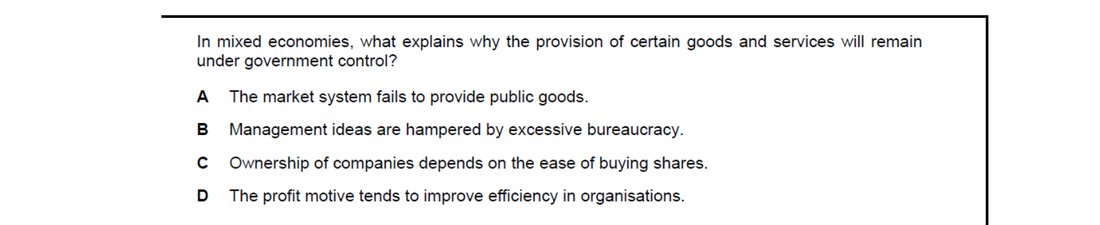
Pure markets under-provide public goods because they are non-excludable and non-rival, generating the free-rider problem. Even mixed economies therefore keep public-good provision under government control. Option A – the market system fails to provide public goods – identifies this market-failure rationale. The other options (B, C, D) describe drawbacks or features of state ownership, not reasons why public provision is retained.

A planned economy is characterised by state ownership of resources, with central planners directing production rather than the price mechanism. Option B – all goods and services are produced by state-owned firms – matches this defining feature. Option A describes a free market, option D the price mechanism, and option C describes a mixed economy where ownership is split by type of good.
Attempt the practice questions above to build your score.
Self-evaluation checklist
After studying this chapter, you should be able to:
- Understand the roles of government and the market in the three types of economic system: market, planned, mixed.
- Analyse the advantages and disadvantages of resource allocation in each of the economic systems.
Want more practice? Drill this chapter's past-paper MCQs (46 questions) →